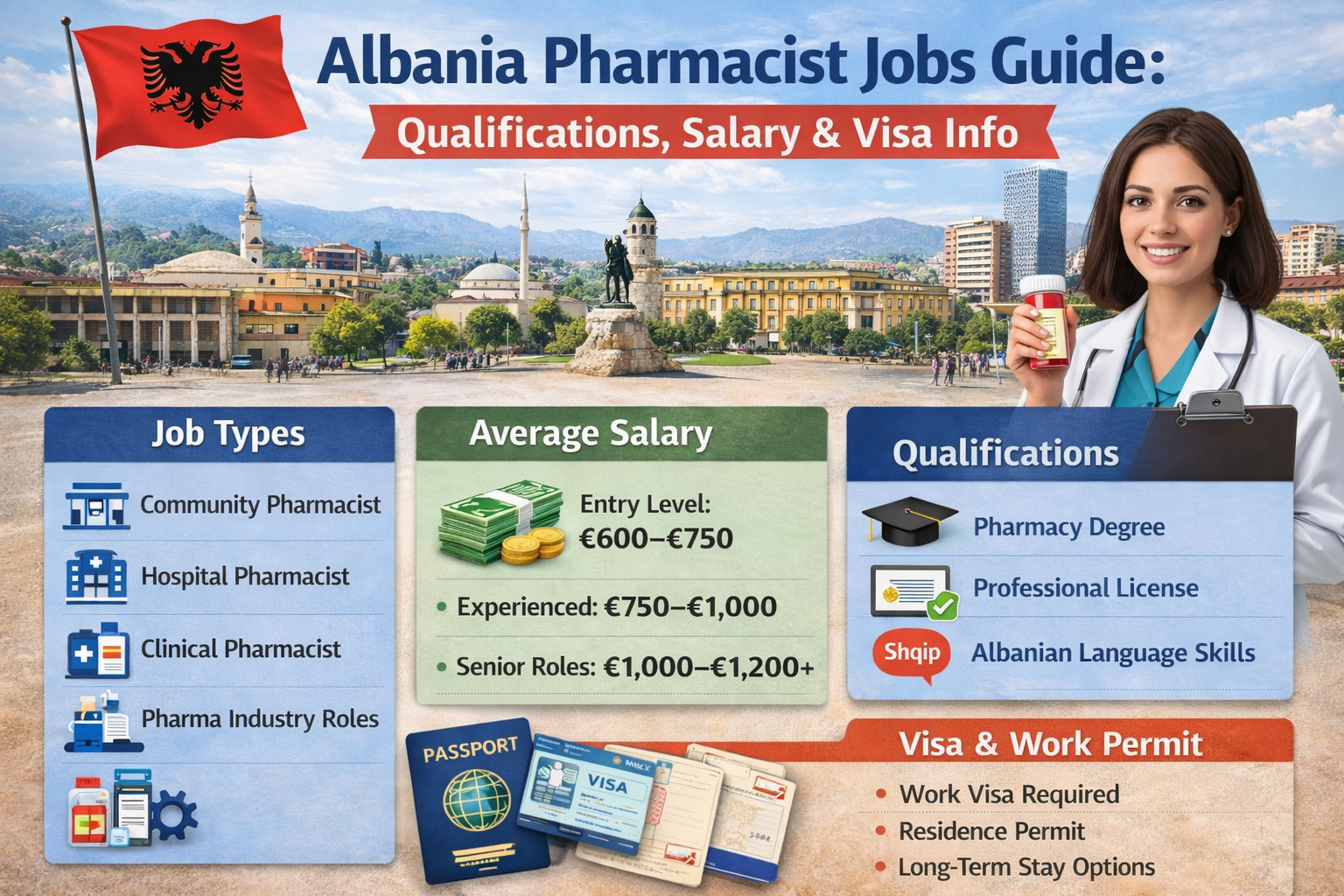
Learn about pharmacist jobs in Albania, including qualifications, salary expectations, visa requirements, and career growth opportunities in 2025
Albania is a small yet steadily advancing European country where the healthcare sector is undergoing noticeable transformation. With ongoing government reforms, increased private-sector involvement, and growing public awareness about medication safety, the demand for qualified pharmacy professionals has shown consistent improvement. Today, pharmacists in Albania play a much broader role than simple medicine dispensing—they actively contribute to patient education, medication safety, and overall healthcare quality.
Alongside local pharmacy graduates, Albania is also attracting international professionals who wish to gain European work experience without facing the intense competition found in more developed EU countries. This makes Albania an appealing option for pharmacists seeking career stability, regional exposure, and long-term professional growth.
This guide provides a complete and original overview of pharmacist jobs in Albania, covering qualifications, salary expectations, licensing requirements, visa procedures, working conditions, and career prospects.
Pharmacist Jobs in Albania 2025 – Job Overview
| Category | Details |
|---|---|
| Job Titles | Pharmacist, Hospital Pharmacist, Clinical Pharmacist |
| Employment Type | Full-Time / Part-Time |
| Industry | Healthcare & Pharmaceutical Services |
| Monthly Salary | €600 – €1,200+ |
| Education Required | Bachelor’s or Master’s in Pharmacy |
| Experience Level | Entry-Level to 5+ Years |
| Professional License | Mandatory (National Pharmacy Authority) |
| Work Visa | Required for Non-EU Citizens |
| Key Cities | Tirana, Durrës, Vlorë, Shkodër |
| Market Demand | Gradually Increasing |
Albania’s Healthcare Sector and Growing Pharmacy Needs
Albania operates a bit of a split healthcare system—public hospitals try to provide the basics, but in many urban areas it’s actually private clinics and pharmacies that are really starting to take off. This expansion is creating jobs for pharmacists who’ve got the training to fill them.
There are a few things driving the growing need for folks with a pharmacy background:
- The number of private pharmacies is going up—and with retail chains joining the mix, there are more opportunities out there for pharmacists than ever before.
- More imported and generic medicines are becoming available—which means people are getting more options, but it also means that pharmacists have to be able to advise on the right choices.
For whatever reason, there’s more of a focus on making sure prescriptions are accurate and that patients get the right advice on their meds.
Given that the pharmaceutical distribution networks are expanding and that European regulations are starting to kick in, it’s not hard to see why experienced, well-trained pharmacists are starting to become a real asset to Albania’s healthcare system.
The Role and Responsibilities of Pharmacists in Albania
The day-to-day stuff that pharmacists do varies depending on where they work, but at its heart it’s a mix of doing some pretty important work in a clinical sense, with administrative tasks too.
Some of the Key Pharmacy Jobs
- Dispensing meds—both prescription and nonprescription ones
- Helping patients understand how to use their meds safely and what to be on the lookout for in terms of potential side effects.
- Keeping an eye on how medications are being stored and handled to make sure they don’t get wasted or go off
- Keeping an eye on stock levels, and making sure that medications havent gone past their use-by date
- Generally making sure that they’re following the right laws and ethics when it comes to handling medications.
Beyond Just Dispensing, Pharmacists also have a number of support roles.
- They work with doctors and nurses on a regular basis to make sure that patients are getting the right treatment.
- They’re on the lookout for potential interactions or allergies that could cause problems.
- They also get involved in helping with patients who are taking long-term medications
Admin Tasks too
- Keeping accurate records, and making sure that everything is up-to-date
- Preparing paperwork for inspections—a chore thats never fun, but somebody has to do it.
- Managing the day-to-day running of the pharmacy, which can mean supervising assistants and technicians.
As you get more senior, you might find yourself looking at management, procurement-type roles, or supply-chain-related positions.
Types of Pharmacist Jobs in Albania
Pharmacy professionals in Albania can choose from several career paths based on experience and specialization.
Community (Retail) Pharmacist
- Most common role
- High level of patient interaction
- Fixed and predictable working hours
Hospital Pharmacist
- Employment in public or private hospitals
- Management of inpatient medications
- Support for clinical treatment teams
Clinical Pharmacist
- Advanced and specialized role
- Focus on optimizing treatment outcomes
- Prior experience usually required
Pharmaceutical Industry Roles
- Medical sales representative
- Quality assurance assistant
- Regulatory affairs support officer
- Distribution and logistics coordinator
Pharmacist Salary in Albania (2025)
Pharmacist salaries vary depending on professional experience, employer type, and city.
Average Monthly Earnings
- New Graduates: €600–€750
- Mid-Level Pharmacists: €750 – €1,000
- Senior or Managerial Roles: €1,000–€1,200+
Private-sector employers generally offer higher compensation than public pharmacies.
Additional Employment Benefits
- Paid annual leave
- Health insurance contributions
- Performance-based incentives (private sector)
- Stable employment conditions
- Balanced work-life schedule
Due to Albania’s affordable living costs, pharmacists are often able to maintain a comfortable standard of living.
Getting Qualified to Work as a Pharmacist in Albania
What You Need to Study
- A Bachelor’s degree in Pharmacy is the bare minimum—ideally, you’d have a Master’s as well for higher-level roles
- Make sure you have your academic credentials officially recognized
Getting Licensed
- You’ll need to get yourself registered with the Order of Pharmacists of Albania.
- Need to verify your qualifications with official documents.
- Don’t forget to meet the professional conduct standards—this is super important
And if you trained outside of Albania, you’ll need to send in your degree and any certified translation into English (if that’s not already done)
What You Need to be Good At—Skills and Language Requirements
Technical Know-How How
- You need to have a proper grip on pharmacology.
- Making sure prescriptions are accurate is vital.
- Knowing how to keep medication safe is a big part of the job.
- Keeping track of stock is also a task you’ll be doing often
Getting Along with People
- You need to be able to communicate clearly.
- You’ll be working with patients a lot, so empathy is a must.
- Double-check your work—accuracy is key
- And don’t forget to be professional—all the time
Language Skills
- Albanian is often a requirement for most day-to-day work.
- English is a bonus if you’re looking at working in private or international setups.
- Speaking even a little bit of Albanian will make you a lot more employable
Working as a Pharmacist in Albania—Visa and Permit Requirements
If you’re not from the EU, you’re going to need a work visa and residence permit to do the job legally
Getting Your Visa
- First you’ll need to get a job offer confirmed in writing.
- Your employer needs to sort out a work authorization.
- Then you apply for a Type D long-term visa—not the easiest process but necessary.
- As soon as you get to Albania you can get your residence permit sorted
Benefits of Having a Work Permit in Albania
- You can work on the books.
- You get to stay in the country for as long as you want.
- Healthcare services will be available to you.
- And after a while, you can apply for long-term residency
Finding a Pharmacist Job in Albania
Job Hunting Tips & Tricks
- Browse around local job posting websites, check out whats on offer and reach out to a few of the bigger pharmacy chains to see if theyve got any openings coming up
- If there are any hospitals or distributors in the area, make an effort to get in touch with them and let them know you’re on the market—who knows what might happen?
- Make sure to get your professional CV in order and get it to as many places as possible—a little extra legwork never hurt anyone
Stuff You’ll Need To Apply
- An up-to-date resume that shows off your qualifications
- Copies of your pharmacy degree, because you never know when someone will ask
- Proof that youve got the right skills to work in Albania—this might include a letter from the relevant authorities
- A good cover letter shows them you mean business
- If they ask for it – a bit of proof that you can speak the local language
What You Can Expect In A Job
Working as a pharmacist in Albania comes with a few perks—for one, your working hours are pretty standard; no all-nighters here. Also, the demand for pharmacists in the major cities is high, so you’re going to find plenty of job opportunities. You might even be able to move up the career ladder and into a role like a pharmacy owner or a pharmaceutical sales manager.
Conclusion
Albanian pharmacist jobs are a pretty stable and growing field for people who want to put their skills to use in a major European healthcare market, even if the pay is a little lower than you might be used to in some parts of the world. But you will get to live in a country that has a lower cost of living and plenty of work to be done. And with all the modernization going on, the chances are the demand for skilled pharmacists is only going to go up. rise further.